



Shipping Container Model Home
Affordable housing has become a growing concern in many places around the world. This project provides a solution to the affordable housing crisis in Jamaica. Buildings made from shipping containers are already common across the island; however, shipping container homes are still a more novel concept there.
The home consists of two 40-foot shipping containers, connected in the centre. Shipping containers are known for their compact form factors, with their width spanning 8 feet. To create an interior that felt spacious, the kitchen, eating area, and living room were placed in the wider connected portion of the shipping containers. The open space in the common areas of the house allows natural light to flood the interior, while providing a seamless flow between the different spaces.
Building a home from materials that were not initially intended for architecture presents many unique challenges. One of the biggest challenges, however, was the stigma attached to dwellings made of shipping containers in Jamaica. Many would prefer to reclad the corrugated metal facade of the shipping containers, hiding the shipping containers entirely, leading to increased project costs.
Preserving the visual identity of the shipping containers for this model home was important. Exposing the raw materials of shipping containers provides a sense of beauty grounded in the honesty of the materials used.
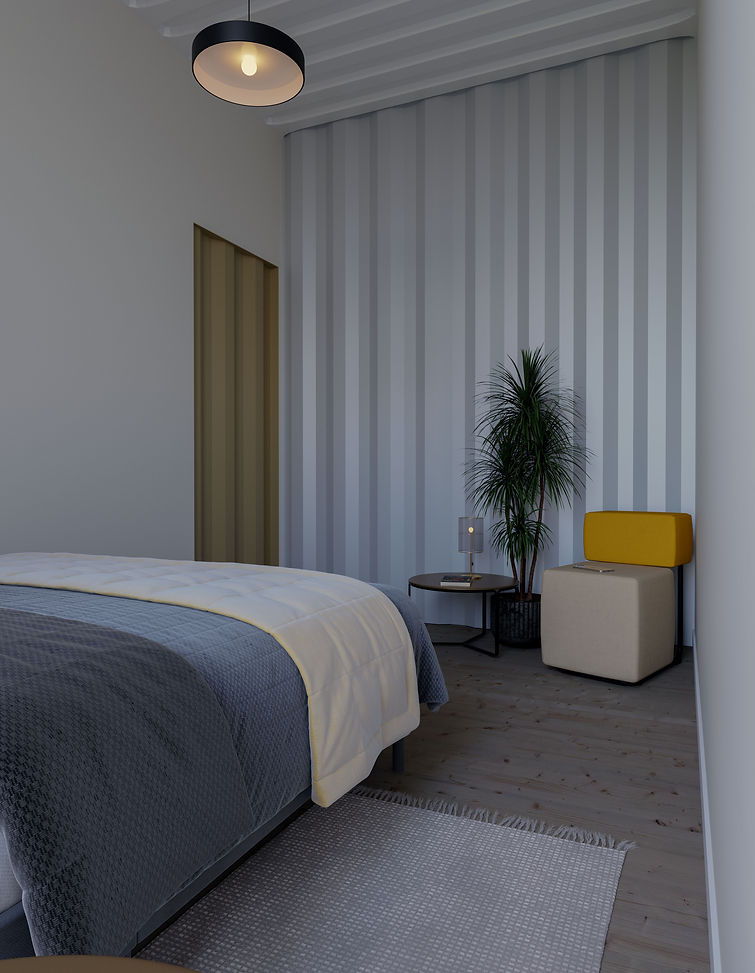
To create an interior that was harmonious with the industrial nature of the shipping containers, the Bauhaus principles were referenced. Metal and glass were paired with traditional materials, such as wood and leather, to create an interior that prioritized simplicity and comfort.
The primary colours, yellow and blue, were mainly used along with a subtle touch of red. White and black were also used to produce a pleasing contrast, balanced with the primary colours. Beige and brown were added to create warmth, and incorporating wood provided a natural touch while complementing the preserved wood floors of the shipping containers.
The metal roof of the shipping containers was exposed on the interior, and the corrugated metal sides were used for some of the partition walls and interior doors. For this interior, it was necessary to retain some of the visual identity of the shipping containers while ensuring the spaces did not feel confined like the interior of a typical shipping container.
